


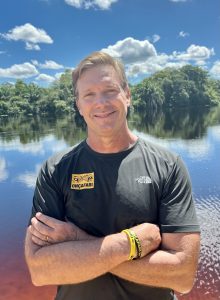
What happens when a former Formula One and IndyCar driver decides his next challenge is saving one of the world’s most iconic big cats? In this episode of Access to Inspiration, Sue Stockdale speaks with Brazilian conservationist and former racing driver Mario Haberfeld, founder of Onçafari, one of South America’s leading wildlife conservation organisations.
Mario shares how a childhood journey to Africa sparked a lifelong fascination with wildlife, a passion that remained alive throughout a successful motorsport career. After retiring from racing, Mario embarked on a two-year global journey to understand conservation efforts around the world. What emerged was a bold vision which has evolved since 2011: to create a sustainable future for jaguars in Brazil through ecotourism, scientific research, habitat protection and community engagement.
Mario explains how Onçafari pioneered the habituation of wild jaguars, transforming wildlife tourism in Brazil’s Pantanal region while creating economic opportunities for local communities. He also discusses the growing threat of climate-driven wildfires, the importance of long-term thinking, and the ambitious Jaguar Rivers Initiative, a multinational effort to connect wildlife corridors across Brazil, Argentina, Paraguay and Bolivia. This conversation explores leadership, perseverance, teamwork and the power of following a passion.
In this episode, you will learn:
- How a childhood trip to Africa inspired Mario’s conservation journey
- Why he transitioned from professional motorsport to wildlife protection
- The pioneering work Onçafari has done to habituate jaguars safely
- How ecotourism can support both conservation and local communities
- Why climate change and wildfires are now among the greatest threats to biodiversity
- What motorsport taught Mario about leadership, teamwork and resilience
- The vision behind the Jaguar Rivers Initiative and its international impact
- Advice for anyone wanting to create meaningful change in the world
Key Quotes
“If your passion is big enough to accept the challenges, then everything is achievable.”
“I feel a lot more complete nowadays than when I was doing motor racing because here we’re really leaving a legacy for the next generations.”
“The only advice I would have given my younger self would have been to start earlier.”
About Mario Haberfeld
Mario Haberfeld is a leader in wildlife conservation, known for his dedication to protecting Brazil’s biodiversity. Raised in São Paulo, Mario nurtured two lifelong passions: racing cars and wildlife. Before entering the conservation world, he enjoyed a successful career as a race car driver, competing in international championships, including stints in Formula 1 and Indy Cars. In 2011, Mario shifted his focus to conservation and founded Onçafari, an initiative dedicated to protecting Brazil’s biodiversity through ecotourism, scientific research, and community development.
Under his leadership, Onçafari pioneered the habituation of jaguars for ecotourism in the Pantanal and has since expanded to multiple biomes, safeguarding over 2 million hectares (5 million acres) of natural habitat. Mario is also co-leading the Jaguar Rivers Initiative, in partnership with Rewilding Argentina, Nativa Bolivia, and Fundación Moisés Bertoni, a groundbreaking, multi-country effort to establish ecological corridors that connect jaguar populations across Brazil, Bolivia, Paraguay, and beyond — one of the most ambitious landscape-scale conservation projects in the region. Mario is a strong advocate for wildlife protection, using education and media to elevate awareness and environmental stewardship across Brazil.
Beyond his organizational work, Haberfeld is a co-author of three books, “Jaguar Within the Pantanal Culture,” “Wild Soul,” and “Panthera Onca: In The Shadow of the Forests,” and has co-produced three documentaries: “Jaguar: Closer Than Ever Thought Possible,” “Jaguars: Brazil’s Super Cats,” and “Diary of a Jaguar.” His work has been widely recognized. Mario received the Folha de São Paulo Social Innovator of the Year award (2025), the LATA Excellence Award in the Unsung Hero category (2025), and the Schwab Foundation Social Innovation Award (2026). Under his leadership, Onçafari was named one of the 100 Best Brazilian NGOs (2024 and 2025) and received Condé Nast Traveler’s Bright Ideas award in the Travel Organizations & Operators category (2024).
Connect with Mario Haberfeld website : Linkedin : Instagram
Connect with Access to Inspiration: Twitter | Facebook | Instagram | LinkedIn
If you are enjoying this not for profit podcast – Say thanks…and become a supporter to help us continue producing quality audio content for our listeners. Click on link to make a small donation and leave us a message.
Episodes with other guests we recommend are:
150. Kris Tompkins: Conservation, Leadership and Legacy
143. Astrid Vargas: Saving species, regenerating landscapes and inspiring action
126. Sofia Heinonen: Rewilding Argentina
Mario Haberfeld Transcription
sue: Welcome to the podcast, Mario. It’s lovely to speak to you today.
mario: Thank you, Sue. It’s a pleasure being with you here. Thanks for the invitation.
sue: We’ve got a lot of, lot to get into today to discover all the good work that you’re doing down there in Brazil.
Africa Trip Inspiration
sue: And maybe a good place to start is to take you back to when you were a youngster travelling with your father, in Africa. I’m wondering in your early journeys as a, a young boy, – given our podcast called Access to Inspiration, in what ways did those journeys inspire you?
mario: Yeah, I think I’ve always liked wildlife a lot. So I was lucky enough that when I was 12, my dad took the family to Africa. At that time, it was a very different experience from what it is today that you have these very nice hotels with, I don’t know, swimming pools . At that time, it was very rustic.
We went with our family and a group of other guests sitting in the back of a truck, we would drive all the way the whole day inside the Serengeti in Tanzania. at the end of the day, we would each build our own tents and cook our own food. So it was very rustic. But yeah, I guess I fell in love with Africa, with wild animals. And later on in my life, I think it inspired me to create Oncafari and what we do today.
sue: So it’s amazing what inspiration we can get from our travels and learning about other places.
Racing to Conservation
sue: In between though, you did have a career as a Formula One racing driver, and it does seem quite a reinvention to go from the racing circuits and the world of motor sport into conservation and ecotourism and focusing on Jaguars. So what caused you to make that switch?.
mario: I think that trip that we just talked about to Africa really, created the roots for trying to save wildlife. When I was at school, when I was a young boy, I wanted actually to be a veterinarian, but I always had two big passions in my life, which was motor racing and wildlife. Motor racing had to come first because you need to be young to drive those cars. And I raced cars for 20 years. I lived in the UK for nine years and then 18 years in the US doing Indy cars and other categories, but when I retired in 2008, I still had this passion and I still have this passion for wildlife, and I really wanted to work with wildlife protecting animals.
The problem was, not a scientist, I’m not a biologist, I’m not a veterinarian, and I had no idea on, how to follow that dream or that career, I took a two year, sabbatical travelling all over the world trying to see what was being done in terms of conservation with big animals, big mammals, mainly big cats.
So I went to India, Africa I don’t know, Uganda to see gorillas, polar bears in Canada, panda bears in China and everything. And from all those trips what I found is that the best way I could protect Brazilian wildlife at the time was by developing ecotourism based on watching big cats. So pretty much safaris are done in Africa with leopards and lion, we wanted to replicate that here in Brazil with Jaguars.
sue: I think what you’re saying there is a journey of learning, first of all, to understand what it takes, and then deciding to go ahead and set up Oncafari. Of course, one of the, challenges, as you also describe it there, is how do you make the environment comfortable for the Jaguars, in Brazil with Safari vehicles or human beings? Because that’s something that has evolved in Africa and other parts of the world. Isn’t that one of the biggest challenges?.
Starting in Pantanal
mario: Yes, I think first of all was finding a good place to start this kind of, process. Jaguars, they occur pretty much in every biome here in Brazil. Unfortunately, they’re extincting the Pampas, which is the furthest southern biome here in Brazil. But we though the Pantanal, biggest wetland in the world something, let’s say, similar environment-wise to the Ocavango Delta, so a bit more open spaces. We thought the Pantanal was the best place to start. And we travelled a lot around the Pantanal trying to find the ideal property to start. We came up to Caiman, which is where Oncafari started. It’s a 53,000 hectare reserve where they had the ecotourism going there for roughly 20 years before Oncafari, but seeing the jaguars was a big challenge. And in Pantanao especially, that’s a challenge because Pantanal is a very cattle ranching, rich culture. So you have cattle ranching there for over 250 years, and where you have cattle and jaguars, obviously from time to time there’s a conflict. So despite being illegal to hunt in Brazil, you can’t hunt anything at all since 1967 the Pantanal, the smallest bio in Brazil, but still very large. You can fit Austria, Switzerland, and Belgium inside and still have space left, and very inaccessible. So we are sure that hunting jaguars happen from time to time illegally, Jaguars learned that a long time ago. So they were always very skittish, let’s say, of people, and if they wanna hide, hide, it’s impossible to find them.
Habituating Jaguars
mario: So what we’ve done is try to adapt what was done in South Africa roughly 50 years ago with leopards to Jaguars in Pantanal, which is a process called habituation. So it doesn’t involve feeding the cats, it doesn’t involve domesticating it’s simply following the same animal in our case, a female jaguar called Esperanza that means hope in Portuguese.
So following her for roughly two years, pretty much every day, she was running away, but with time she started relaxing, she must have though, “You know what? These guys follow me every day, nothing happens, they go away, I’m alive so why am I running?” And then we started seeing her more and more until she had cubs. When she had cubs, the cubs copied the behaviour of the mother so they weren’t so afraid of the vehicles and they were born pretty much seeing our vehicles there from from day one. So then they became super, relaxed in front of us when they had cubs were even more relaxed. And what I say nowadays is you arrive at a sighting, they don’t even look at the car, for them, we are like a tree, like a tree that moves, but for them, there’s no at all, it doesn’t mean anything good, it doesn’t mean anything bad, it’s just something that’s there and they go, about their life. I think the way we started is by, let’s say, pioneering this method of habituation with jaguars here in Brazil.
sue: That makes a lot of sense in terms of the process that you used to get the Jaguars familiar with vehicles and human beings in that context.
Oncafari Expands Mission
sue: I’m curious then to know how you then grew the mission of Oncafari. What was your long-term vision when you started up? Where did you want the organisation to get to in the future?.
mario: Yeah, I I say these people don’t believe, but honestly, when we started, all I wanted to do is see a jaguar, it sounded like something already audacious enough obviously worked very well. They used to see two sightings a year. Now we have, I don’t know, 1200 sightings a year, pretty much everybody that went there the last five, 10 years have seen jaguars.
With that, we started learning about jaguars, a lot about jaguar behaviour. So we said, “Let’s start a scientific part of Oncafari where we do a lot of different studies from diseases, DNA, obviously behaviour, the dispersion of territories, and so on.” Then we said, but conservation, it’s really about people, right?
If you didn’t have people, you didn’t need to do conservation. So you need to make sure that people that live in those territories benefit from all these actions. So we started a social part of Oncafari, creating jobs for women that in a cattle culture, it’s not so common. So now with ecotourism, women had a lot of opportunities. Obviously everybody now have chances of better jobs than just being, a cowboy. We said if we do this in the middle of the Pantanal and nobody knows about it, it’s not having the effect that we want.” So we created what we call an education part, so giving talks pretty much all over the world in public schools, in companies, in universities, publishing books producing documentaries helping big production companies produce documentaries on jaguars or main wolves, that’s another species we work with, always trying to get the word of conservation to a broader audience. In the meantime, we did jaguar rewilding, so getting calves that had end up in zoos, teaching them how to hunt. And I think we were the first successful project to ever do that in the world, and we’ve been doing this in different biomes until we got to the point that we noticed, okay, we’re protecting these jaguars in these different areas, but jaguars need huge areas to live and for populations to be viable.
So since 2019, we’ve been buying land normally land that’s still protected under threat of deforestation, [00:11:00] and in strategic areas that by buying that piece of land, we can involve other stakeholders, other landowners to agree to a sustainable development, and with that, create big wildlife corridors.
I think that’s where the organisation is more focused because it’s where we have the biggest impact so much so that nowadays we have a new project that was launched in Climate Week last year with three other partners in Bolivia, Paraguay, and Argentina trying to connect this big wildlife corridors between the countries.
It went from trying to see a Jaguar to work, working internationally. But if you ask me when I started Oncafari, if I imagine we would do all of that, I didn’t, but I think through, a committed team and trying to always improve and have the biggest impact as possible we managed to grow that way.
sue: It sounds like an amazing story of growth Mario. On our podcast on episode 126, we’ve had Sophia Heinonen from Rewilding Argentina, one of your partners. And also we’ve had our episode 150, we’ve spoken to Kris Tompkins who, was doing a, a lot of pioneer work also down in Chile and Argentina. So we’re loving that we can help to spread the word of all that great work that’s going on down there in South America.
Biggest Challenges Fires
sue: Listening to what you’re saying, Mario, that all sounds fantastic, but surely it isn’t quite as easy as that. I bet there’s been a lot of challenges along the way.” What have been the most difficult things that you’ve had to face and overcome to get to where you are today?
mario: Yeah, I think, honestly, just to start Oncafari was a big challenge because here in Brazil, all the animals are owned by the country, so to work with Jaguar, we needed a lot of different licences, and you can imagine me going to ask for licence to work with Jaguars with all the Jaguar specialists saying that I wanted to work with Jaguars, which, it’s pretty high standard to start with, that I wanted to do habituation that nobody ever heard about, and that my background was a race car driver.
So you can imagine everybody was very sceptical of that. But once we started, I think everything went well obviously every day there’s a different challenge, but I think our biggest challenge that we started facing since 2019, more or less, and it’s still the biggest threat to everything we do, is fires,
with climate change with the world warming up, with Pantanal, for instance losing about 60% of its water in the last four years fires is all the time more present. So nowadays we even have a, a part of Oncafari that works with fire prevention training teams, detecting fires early, having private fire brigades because everywhere we work, it’s so isolated that you can’t call the firemen, it’s gonna take them three, four days to get there, and by then it’s too late. we have a whole team nowadays dedicated in Brazilia, the capital of Brazil, in an office, just looking at satellites, cameras organising the firebreaks in every reserve, and then all the teams on the ground ready to, to go into action if something happened, and doing all the fire prevention techniques that we developed, copied and so on. So I think this is a, a huge problem. It’s where we spent most of our funds nowadays because everything we do, if it catches fire, it goes down the drain,
to really be on top of that, but unfortunately, it’s a battle that, we’ll win sometimes, but most of the times it’s gonna be impossible to control. I think it’s much bigger than Oncafari, much bigger than all of us, and it would take the, the world to agree on stopping everything we do that influences climate change. But we’re fighting as much as we can.
Funding and Community Wins
sue: I think what also strikes me, Mario, is that it’s a very long term ambition that you have. It’s a very long term commitment and it does require that patience. And yet often funders want instant results. I imagine local people, they want instant results, benefits to their economy. How do you balance that short term thinking versus long term thinking?
mario: I think in the beginning, it was much harder. We were arriving, in the Pantanal, we were quote unquote foreigners from other places of Brazil saying that we wanna help Jaguars, which they saw Jaguars the threat that were eating their cattle. It was very hard and to a certain extent, it’s still hard when we access new areas, only now we have to show and people that can, let’s say, talk on our behalf and say that things are actually gonna happen.
I would say it was harder in the beginning. I think we were fortunate to have a lot of different corporate sponsors from the beginning and more and more working with them. I think now is conscious about climate change and wanna do their part in trying to help. So everything we do at Oncafari, we have sponsors that not only fund us, but give us products like vehicles, tyres, airfares, law company, insurance everything so we don’t have to spend funds with those things. And philanthropies that, are normally more patient than, you’re getting a loan on the bank or a real investor, a capital venture investor. I think it was harder at the beginning. Nowadays, people seen our track record and understand that these things take a long time, but I think along the way we managed to show results, both with the community.
One of the persons that work with us, he was a, a cowboy, probably made a minimum salary working at a ranch. we train him, we sent him to Africa, he spent a few months there. He learned to speak English, so he’s now one of the best guides we have he had never before that left the little town where we operate near there. And now he’s been with us for over 10 years, and he went on holiday this July to Disneyland in Japan. So you can imagine how much hislife changed from working with Jaguars and seeing the value in wildlife. So those are great examples, that other people get inspired, and obviously the more people we can, influence, the more people we can help, we create better jobs and they can grow the better it is for everybody. And by managing to habituate Jaguars influence the number of guests that visit the, the lodges where we work with. The landowners are happy the government is happy because we’re creating this corridor. So in the end of the day, like you said, this is not free, but but I think by showing results, showing being transparent and everything we do yeah, it takes time. There’s no other way with nature. It’s it’s the way it is. So I think, honestly, we were fortunate enough to find people that believe in the same and are happy to wait, but in the end of the day, at some point, you have to show results.
sue: That is the number one thing, isn’t it?
Lessons from Motorsport
sue: I just want to come back to your earlier life in motor sport do you think there’s anything you’ve drawn upon and learned from that part of your life and career that you bring into your work today?
mario: Yeah, definitely. I think there’s a lot of things. Working with companies, sponsors and everything, it’s pretty similar what I did before to what we do now. I think teamwork is a big part. I think everybody thinks motor racing, it’s just a driver, so it’s not a team sport, but I argue that it’s very much a team sport because there’s, I don’t know, millions of screws and things in the car. If one person forgets one of the thing lose, you’re gonna crash or not finish the race. So teamwork, I think it’s very important and in conservation where there’s a thing that, one conservation project wants to compete with the other, and I think this is completely wrong, the challenge is so big and those are not the enemies you need to work together to to fight and push towards a more conserved planet. and I think attention to detail, again, in motor racing, you’re talking about hundreds of a second so everything needs to be perfect if you are to have any chance to succeed, and I believe that, that works for any business. And also this drive to be always pushing forward, always in a rush, let’s say, because unfortunately, every tree that gets planted nowadays, I don’t know, two or three are taken down. We really have to be, pushing every day and be wanting to do things more efficiently and faster so we have a better chance of succeeding.
sue: So it sounds like quite a few connections there. And of course our co-founder of this podcast, Clive Steeper in episode one talked about going fast in business in motor sport given his experience in that world as well. Just again, sticking on your own experience and the things you’ve learned along the journey, Mario, if young Mario, that young man that went off to Africa, met today’s Mario, what do you think would surprise him most about what’s happened to you?
mario: I don’t know. I think to see how, first to say how lucky you are, because you had two passions and you managed to work with both of them, I think, unfortunately, not something that everybody can do it. So I think that’s one thing. And seeing how far we’ve gone with Oncafari, like I said, I never imagined that we would be working, across borders and everything.
The only advice would have been to have started earlier because hopefully we would have had a bigger impact in years past. But, yeah, I think I’m very proud of what we’ve achieved so far. We have a great team here at Oncafari, that are, very committed. Everybody’s very passionate and dedicated to what we do, and this is very important, right?
Having the right people doing the right things and always with a purpose. I feel a lot more complete, let’s say, la – nowadays when I was doing motor racing despite loving what I did before, because in motor racing it’s great, but you’re winning races and championships and so on. But here, really l- leaving a legacy for the next generations, and hopefully we still have a lot of things to do and live an even bigger legacy. My biggest job or my biggest worry nowadays is making sure when I’m not here Oncafari’s self-sustainable, be it with endowment funds or other things we do and having the right people pushing it forward, because it’s been a lot of hard work to get up to here, and we need to make sure it continues forever.
sue: Absolutely.
Advice for Changemakers
sue: I’m sure that many of the listeners are thinking what’s the checklist? What’s the go-to list for somebody who has passion, who sees the changes in the world and the environment and maybe wants to do something themselves? Just like you had that passion when you were young, you wanted to see a Jaguar you have made it sound achievable today in the success and the journey that you’ve had, Mario. Often the first step for people is the biggest challenge. They don’t know how to begin.
What would you offer for somebody who’s got passion, who’s got drive, who sees that they need to make a difference in the world, but they don’t know where to start?
mario: I think the biggest thing is to be willing to change and to be humble enough to say, “Look I don’t know anything about this and I need to learn, and always be pushing to, to learn as much as you can so you can do it properly.” I think you have to have a big willingness to struggle because it all sounds easy, all sounds fine, but again, every day, it’s a battle. But if you’re willing to struggle enough for a bigger dream I think everything is achievable. Obviously, there’s times you wanna give up, bad things happen but if you really are passionate about it and are really committed to it, then you always find support, you always go over that hurdle until the, the next one.
But say those two things, really trying to learn as much as you can about what you wanna do. Again, I had the opportunity to travel all over the world and see what had been done before and learn a lot. In order to adapt to Brazil and the conditions we work with. And I still say I’m still a lot of them don’t know.
I’m trying to learn every day trying to hire a lot of people that know a lot more than I do because, again, time is of the essence. There’s no time for me to, be learning and I will never know everything. Put the right people in the right place and just accept that not every day it’s a great day, but you have to keep pushing to to succeed. So if your passion is big enough to accept those challenges, let’s say yeah, I think everything is achievable.
Jaguar Rivers Initiative
sue: You mentioned before the Jaguar Rivers Initiative with the different organisations that are involved tell me about that grand ambition and what’s the next steps that’s happening with that?
mario: Yeah, I think the, the biggest thing is that conservation can have no borders, right? I joke that every time a Jaguar crosses the border from Bolivia to Brazil, it doesn’t have to show the passport. The same is true for fires. So if we wanna be, win this battle for conservation or against deforestation and fires and all of that, we need to work in a bigger scale.
We need to work between countries. So the big goal, let’s say, of the Jaguar Rivers Initiative is connecting four country which are in the Parana Basin which is a huge basin. It’s two times the size of England, France, and Italy put together. So it’s a very audacious dream. It’s a 20 year project, but I’m sure it needs to be carried, continue after that. So it’s connecting these big conservation areas in these four countries through the five main rivers that you have in this basin. So the rivers are the, let’s say, the highway for, for the Jaguars to get from one place to the other. So we’re working together with our neighbours, for example, in Bolivia, trying to allow, for instance, when there’s a fire there, Brazilian firemen can go there and help there before the, the fires reach Brazil and hopefully vice versa, creating these corridors where populations of jaguars can con- connect between one or the other researching a lot of different things in the rivers reintroducing species where they’ve gone extinct.
So it’s a very complete project obviously, on the way socially and economically developing and helping the populations that occur , in remote areas. So it’s a project that Kris Tompkins brought to us. We’ve been working together for quite a long time with reintroduction of Jaguars.
We’ve done it in Brazil. They’ve done it in Ibera in Argentina. We actually sent them a Brazilian Jaguar that we’ve done the process of rehabilitation. He was the first male that was released in the wild there in Ibera. So we’ve been working together with them and great team, great people. And Kris came to us a couple years ago, more or less, and said, “Look, I have this new vision. I’d like to invite Oncafari to be our Brazilian partner.” So since then we’ve been working, we’ve identified yeah, Nativa in Bolivia, Moises Bartoni in Paraguay to be our partners in this initiative. And now, yeah, we’re hard at work trying to make everything happen.
As we speak Sophia, whom you also mentioned from Rewilding Argentina and Paola who works with me here, they’re in a boat going down the Paraguay River all the way from Pantanal to Argentina. It’s a long expedition trying to learn the challenges, analysing the water quality, seeing giant otters and so on, talking to communities. Yeah, everybody’s hard at work and it’s been less than a year than we, that we launched this project, and I think a lot has happened already since then.
sue: Fantastic. And I wish you well with that in the future.
Most Memorable Jaguar Moment
sue: As you just reflect on everything that you’ve experienced, is there a standout moment that you’ve had with the Jaguar that you hold in your memory as being extra special?.
mario: Yeah, for me, one very special moment was Esperanza, this first Jaguar we were trying to habituate. I don’t know, after two years or so, she was somewhat hab – habituated. We noticed that she stayed for six days in the same place. She left, one car was able to follow her and make sure where she was. Myself and a couple team members, we went to the area where she stayed for six days because we thought would find a carcass or something that she was feeding on. But to our surprise, we found three little curbs that were, I don’t know, five days old. It was amazing to, to see that. It was a, a big surprise very nice.
And the nicest thing is we have been following the lives of those three cubs. It’s a male and two females. They had cubs on their own, grand cubs of their own. Seeing the, let’s say, the family prosper it’s a very nice thing. But in the end of the day, every Jaguar is different.
Every time is a special moment. And every hectare that we can bring under conservation, we always feel very happy about that. We were talking just now about all the struggles, but there are a lot of rewards as well that makes you feel very good.
sue: It’s lovely to finish our conversation on that note, Mario. It’s been a great pleasure to speak to you today, to hear about the work that you’re doing there in Brazil. It’s such an important role that your organisation is playing. And I wish you every success for creating that legacy for the future that you want to.
mario: Thank you very much. So it’s been a pleasure to be here with you today. Thanks for promoting these kind of initiatives. I think this is always very important so other people know, hopefully other people get inspired and can do similar work in other places and other countries. I think the more the better. Thank you very much. I really appreciate it.
sue: Oh, you’re welcome. And of course, listener, you’ll find links to the website and so on, on our show notes so you can find out more about the organisation and the work that they’re doing.